Infinity Smashed: Born Lucky
Sep. 26th, 2026 04:54 pm![[personal profile]](https://www.dreamwidth.org/img/silk/identity/user.png) lb_lee
lb_leeBorn Lucky
Summary: Specialist Ebony Larkin has a terrible day that starts with fire and ends with more fire, plus Biff in the back seat. Illustrated.
Series: Infinity Smashed (ch. 2)
Word Count: 5100
Notes: This is not the winner of the poll. I just wanted to post it and chose to. It's chapter 2 of the M.D. arc of Infinity Smashed, starting with The Girl Who Got Hit By Lightning. Content warning for Confederate flag Southern tough-boy nonsense.
It was 4AM in the Vago Desert, the storm had blown over, and Specialist Ebony Larkin’s car was on fire.
Summary: Specialist Ebony Larkin has a terrible day that starts with fire and ends with more fire, plus Biff in the back seat. Illustrated.
Series: Infinity Smashed (ch. 2)
Word Count: 5100
Notes: This is not the winner of the poll. I just wanted to post it and chose to. It's chapter 2 of the M.D. arc of Infinity Smashed, starting with The Girl Who Got Hit By Lightning. Content warning for Confederate flag Southern tough-boy nonsense.
It was 4AM in the Vago Desert, the storm had blown over, and Specialist Ebony Larkin’s car was on fire.
She stood there, watching it flame and shaking her head. She looked at her phone, smeared across the dust in pieces of melted plastic and scorched circuits. Phones and cars could be replaced, she told herself; that she was unhurt was a blessing from God—a victory, even if it didn’t feel like one (not to her, and certainly not her workplace).
She hefted the gray canister lying in the dirt. Roughly the size and shape of a yogurt maker, it was cool to the touch and surprisingly heavy, which was good. That meant it was working.
“Johnny,” she murmured to it, “you are more trouble than you’re worth.”
She couldn’t really be mad. She figured in Johnny’s place, she would’ve done the same. Besides, she was too tired. It’d been a long shift, and it was about to get longer.
Her car trunk (the non-flaming half) wouldn’t open. After forcing it with a crowbar (everyone in her line of work carried one), she shoveled out the trunk and left in the dust for the clean-up crew. Her gear bag was fine—well, except for the busted zipper, which her girlfriend had been on her for weeks to get fixed and which Larkin now regretted slacking off on. Making a mental note to tell Taneesha that she’d been right all along (“I always am, baby,” she’d say), Larkin moved the zipper to the midpoint to hold in the cold chamber, then used the little pockets (still working) for water bottle, chill pills, and nothing else. She had a long pre-morning in front of her; Johnny was weight enough.
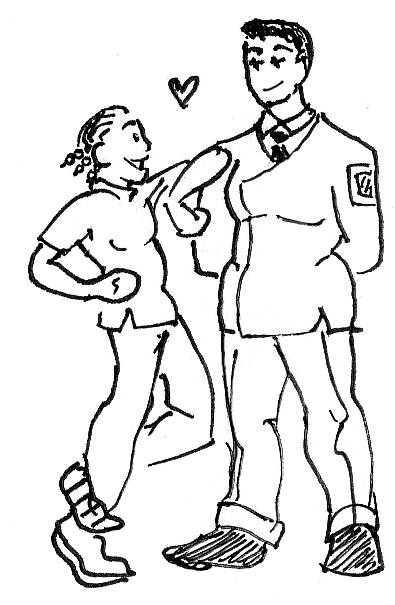
She looked out onto the horizon. Damp dust and rock stretched on either side of the highway as far as she could see, a plain of nothing. The storm had left oppressive swampy humidity, and flapping her open shirt created no cooling breeze. The sun hadn’t risen yet, but when it did…
Larkin propped a pair of sunglasses high in her hair, slung the duffel bag over her shoulder, and started walking.
…
Around 6:15, with her sunglasses down, her water bottle empty, and her shirt soaked with sweat, Larkin trudged into a seedy 24-hour bar on the outskirts of town. It reeked of cheap cigarettes and cheaper beer, but the air conditioning hit her like the heavenly breath of God. For the first time since shift start, she felt dry.
She was the only one. Even at this hour, the bar had more people than she liked, overwhelmingly crowded around a table in one corner. The clientele was mostly white, overwhelmingly male, and all owl-eyed, like they’d been there all night. Some of those reddened eyeballs swiveled her way, and Larkin instantly saw herself the way they surely saw her: skin too dark, hair too short, uniform too fancy.
Fancy, maybe, but no longer nice. Those eyes took in the dirt stains and burnt patches, then immediately refocused on whatever was going on at that table (card game, looked like). Larkin let her breath out. They probably thought she was a gang member, and she was glad.
She dragged herself to the bar and slung the duffel bag down, rolling her aching shoulder. “May I use your phone?”
The bartender didn’t look up from her Naiad romance novel. “Local calls and paying customers only.”
Well, she was dehydrated anyway. Larkin dug into her blackened pocket and pulled out her singed wallet. “Sorrel, if you’ve got it.” Taneesha’s doing, that. “Cranberry juice if not.”
The bartender glanced up. Her expression didn’t change, but there was a labrys tattooed on her shoulder, and her body language softened a little. “Rough night?”
“Aren’t they all?” Larkin replied.
The bartender slid the phone down the counter and said, “I’ll get you a chaser.”
“Much obliged, ma’am,” Larkin said, because she’d been raised right, and took up the receiver.
She dialed the number, listened a moment, punched in the extension. After a moment, the phone informed her that Randall wasn’t in at the moment, but if she could leave a message after the beep, he would return her call as soon—
She hung up, checked her watch, and tried again, with a different extension. It kept ringing, and finally she hung up, sucking her teeth, and tried a different number altogether.
This time she got an instant response: “Specialist Grey.”
Her shoulders relaxed. “Morning, Grey, it’s Larkin. I’m stranded on the edge of the south side, need a pick-up for me and Johnny, plus a clean-up crew for my car. Randall’s bolted for the day, and Agatha’s not picking up.”
She didn’t have to mention she had been out all night; Grey knew what her friend’s schedule was.
After taking down the address and phone number, Grey said, “will tell Comm. Wait half an hour.”
Larkin resisted a sigh. Third/first shift transition was usually pretty quiet (even Vago had trouble getting het up at 6AM), but of course, today of all days, there’d be some cat stampede. “Sure. I need to eat anyway.” Right on time, the barkeep plunked a couple glasses in front of her. “Say good morning to Bob for me. See you soon.”
Click. There. That was done. Larkin took the glass, filled with ice, and pressed it against her forehead. The chill felt wonderful. She gulped the cranberry juice so fast her fillings hurt and then reached for the water.
As she raised it to her lips, a cheer broke out. The group of men playing cards had apparently had a turn-over, and the youngest at the table was now raking in an untidy pile of bills.
He was nothing special—some short white kid with a frizzy mullet and shit-kicker boots, the local tough-boy uniform—but something about his face, the way he moved, bothered her in a way she couldn’t put her finger on. It made her eyes itch. It made her want to look away. It made her want to remember him.
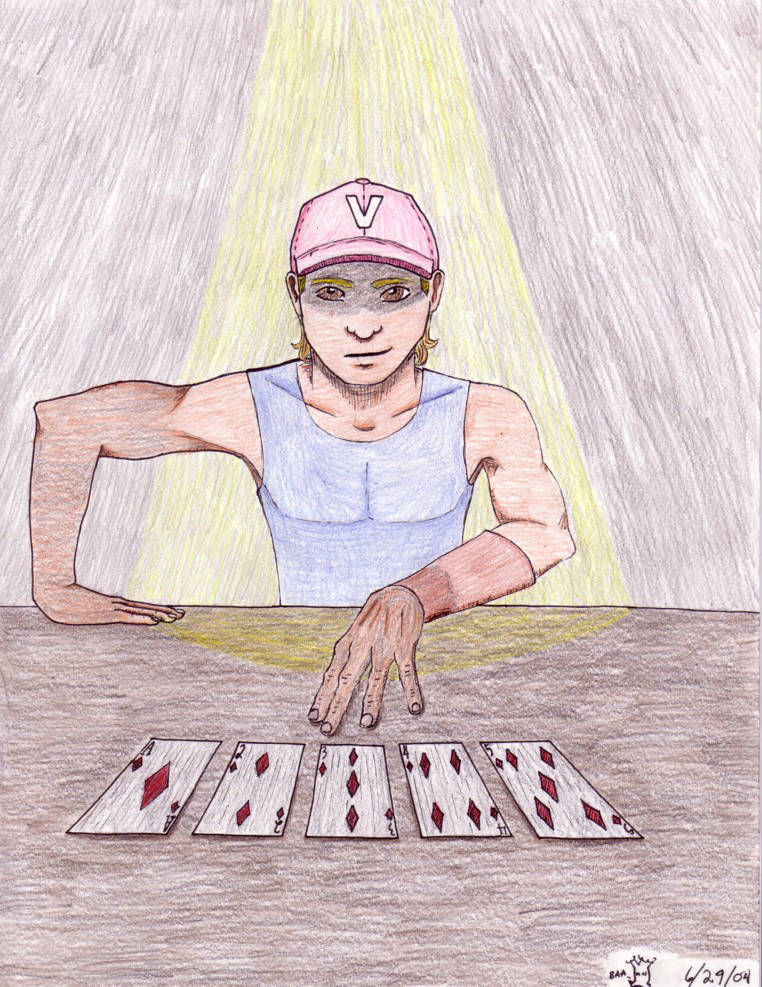
“How do you do it, boy? How do you do it?” people shouted.
He folded his beefy arms behind his head and said in a smug, slurred voice, “born lucky.” Now there was an accent that said he was from Larkin’s side of the Mississippi, even if he was trying to hide it.
Larkin was getting a headache, so she looked away… and discovered that while the crowd might’ve been backslapping and cheering, the other players were ominously still and silent. Not sober, exactly, but a damn sight closer to it than Mr. Lucky, and not at all happy, and for a horrible moment, Larkin thought her shift would end with a bar fight. (Of course, of course drunken Vagans would have the energy for such a damn fool thing at 6AM, God help her…)
But then someone snapped, “deal,” and a new hand started.
Thank you, Jesus.
The bartender caught Larkin watching. “He been winning a while,” she explained, drying a glass with a rag.
“Mm,” Larkin said, sipping her water. “Your boys don’t look too happy about it.”
She shrugged. “They got rent to pay, same as anybody.”
No wonder they looked mad. “Cheating, you think?”
The bartender gave Larkin an incredulous, pitying look. She jerked her chin at Mr. Lucky. He, right on cue, knocked his drink off the table with his elbow, blinked at the crash, turned his head, took another second to look down, whereupon he squinted at the shattered glass as though wondering how it’d gotten there.
Larkin hissed through her teeth.
“Mm-hmm,” the bartender agreed. “Ugly son of a bitch, ain’t he? We know; we just don’t know how… yet.” She shook her head. “Boy must be lucky, ‘cause he sure ain’t smart.”
The other players weren’t even hiding their dark looks and white knuckles now.
Larkin sighed. “How long before they jump him?”
The bartender shrugged philosophically. “Enh.”
Larkin had not been a preacher’s daughter in quite some time, but she remained a deeply faithful woman. Please, Jesus, whatever those card sharks were going to do, let them do it after she left. Please, please, Lord, have mercy. Let Larkin go home, kiss Taneesha good night/morning, draw herself a nice bath full of bubbles and flowery smells, soak her aching body, and fall asleep… maybe in the tub.
She tucked her duffel bag closer to her feet and took a menu. If she was going to do this, she might as well do it on a full stomach, and after the day she’d had, her diet could go to hell.
Larkin had made her order, and another few hands of cards had gone around (the bystanders got louder and louder; the players got quieter and quieter) when the bar phone rang. The bartender picked up, frowned, and turned to Larkin, holding out the receiver. “Robot for you.”
“Thank you, ma’am.” Larkin picked up. “Hi, Grey.”
“Sorry for—”
A roar exploded from the card table. Someone shouted about cheating; glasses and chairs crashed to the floor, and a tidal wave of flesh hurtled at Mr. Lucky.
Larkin hunched over the bar and bellowed, “I can’t hear you, let me just—”
With an air of long tradition, the bartender reached under the bar and came up with a softball bat, but before she got a chance to use it, Mr. Lucky tore free. Shedding dollars, he broke into an unsteady sprint, and… did something.
That was the best Larkin could say: he did something and then everyone’s hands were where he wasn’t. Before she could think further, he smashed into her, almost knocking her off her stool, and when she gripped the bar to keep herself from falling (and automatically clutched her wallet; she’d lived here a while), he snatched up her duffel bag and barreled out the door at full drunken tilt.
With a holler, Larkin slammed the phone down on Grey and bolted after him, hot on the heels of the angry card players (who at least weren’t paying any attention to her).
Outside, the street was deserted. Except for a few loose dollars fluttering to the ground, there was no sign of Mr. Lucky.
The barflies interrogated each other angrily. Larkin ignored them. Damn fool couldn’t have gone far, drunk and weighed down with Johnny, and with all the other establishments still (sensibly) closed so early in the morning, there weren’t many places he could’ve gone. The dollars seemed to be heading left, so she headed towards that alley first. Around her, in her peripheral vision, the barflies fanned out to search, grumbling.
Larkin’s short, dead-end alley proved to be empty, except for a couple shut doors to dark businesses, a chain link fence blocking off the end, and a couple dropped twenties. There was no way on God’s green earth that drunk could’ve climbed that rickety fence that quickly, and it showed nobody on the other side, but Larkin didn’t move. There was still no breeze, those twenties didn’t move there by themselves, and something about that fence was making her eyes itch. She squared her stance and listened for movement.
Nice thing about chain link fences: they were loud. She heard a rattle, and she lunged.
Her hand brushed cloth, and then an invisible fist clipped her stomach, knocking her breath out. But Larkin didn’t care, because she had denim and cotton under her hands, and she yanked and kicked out, trying to trip him up. Her aim wasn’t good, but she heard a “fuck!” and a chiming crash as he collided with the fence. He lurched back into the visible spectrum as his head smacked against one of the posts, and Larkin pinned him before he could disappear again, snatching her handcuffs from her belt and binding one of his thick wrists to the post. Mr. Lucky, still shedding dollars, whirled around and swung at Larkin with her own bag, but she automatically dodged and the busted zipper gave way altogether.
The gray canister went flying into the cinderblock wall alongside them. There was a crash, a hiss, and a gush of vapor.
“Oh, you stupid son of a bitch,” Larkin sighed, and then Johnny ignited with a cough.
It wasn’t much of an ignition. Johnny couldn’t throw off cold sleep that fast, and he didn’t like the humidity. He looked like nothing more than a smoldering cantaloupe a month past expiration, barely enough to set the stray twenties on fire (“Hey! Those’re mine!”) but he rolled away and managed to lurch into the air, making groggy wheezing noises.
Before Larkin could move, some of the barflies barged into the alley, summoned by the commotion. They took one look at Larkin (Mr. Lucky had vanished again), another at the flying, flaming cantaloupe, and froze, like they didn’t know what to think. Apparently Johnny didn’t either, because he didn’t move, and for a moment, Larkin thought that maybe she could salvage this.
Then one of the civilians brayed, “the hell is that?” with the habitual “fuck you” of a city Vagan, and that made up Johnny’s mind: he spat flaming pitch at them.
It was a stupid panic move, a warning shot intended to miss, and it hit a motorcycle on the street—or rather, its saddlebags. The alarm went off with a sorrowful wail, but that only made the barflies decide that this was a situation they cared about.
“The hell is that?”
“My bike! That fucker blew up my bike!”
Johnny couldn’t speak English, but he did understand it, and he could certainly understand the tone. His color lurched to a more dangerous yellow-orange. In his current condition, Larkin doubted he could burn everyone that came at him, or that he wanted to, but he was panicked and disoriented, and that mixed badly with someone whose natural state was on fire.
Larkin raised her hands soothingly, kept her voice slow and smooth even though all she wanted was to scream. “Sir, if you could please leave the area…”
“My fucking bike is on fucking fire!”
With Mr. Lucky disappeared (she could hear the fence rattling behind her but he was cuffed, so she ignored him), the angry barflies couldn’t beat the dickens out of him, but they were willing to accept substitutes. Johnny bobbed slightly in the air, trying to gain altitude, but he was too cold to manage it. Unable to flee, he started making the heaving huff sounds that forewarned an explosion and surged to a brighter yellow.
Larkin had had enough. She’d wrecked her sleep schedule for this shift, a shift she’d only had to take in the first place because some damned 9/11 hire overdid it at a bachelor party, a shift now coming into hour ten. She hadn’t had breakfast, she was overheated and overtired and not paid nearly enough for this bullshit, and if Johnny burned down an alley in sheer panic, she was headed straight for the washroom. Ever since September 11th, the PIN had been itching to get rid of her, and after all her years of toil and service, she refused to get fired and washed over Mr. Lucky.
“Johnny, hold it!” Larkin snapped. Then, turning on the civilians, “and you! Sir! Ain’t nobody hurting nobody today! Understand?”
Everyone shut up and looked at her. More importantly, they did not punch anyone or set anything on fire. Larkin kept on.
“You, sir, your bike is not blown up, we will reimburse you for the damage, and we are very sorry. Johnny, you ain’t hurt nobody yet; we can still work something out without you getting into any more trouble. Let’s all take a deep breath, calm down, and—”
And a chill pill came flying out of the air and hit Johnny dead-on. It burst with a cloud of nitrogen.
Larkin closed her eyes. Mr. Lucky. He still had her bag.
Johnny made a gasping noise, dropped a couple feet, then surged dark orange and took flight with an antagonized roar. Flame started pouring out from his surface, licking up the damp cinderblock wall without catching. That, for Johnny, was the equivalent of the war dance, the threat display, the “I am going to burn every last one of you motherfuckers.”
Finally, the civilians started running. Larkin turned towards Mr. Lucky, kicked blindly (and viciously) in the general vicinity of where his abdomen had to be, but when he wheezed and spun into the visual spectrum again, she saw that her bag strap was over the cuffed arm. Unable to take the bag itself, she yanked the remaining chill pills from it and hurled them at Johnny. Johnny bobbed and dipped and blasted flame; the chill pills protected Larkin from the heat, but dissipated without cooling him down. Relying on their ambient chill, she dove under him for the cold chamber, tried to bring it up. She wasn’t sure it could take down Johnny in this condition, and she prepared for third degree burns.
Then she heard screaming tires. A black sedan came flying down the street and screeched to a halt in front of the alley, ramming the flaming motorcycle out of the way with a sorrowful crunch, which at least shut off the alarm and distracted Johnny enough to swallow his flame for a second.
Specialist Grey threw herself out of the car door, gear bag (with functioning zipper) over her shoulder, digging for a fire extinguisher.
Larkin wrestled herself calm again, even though she was flat on her back underneath a living flamethrower and wanted nothing more than twelve hours’ sleep. “Johnny,” she said, “none of us want this. I’m willing to overlook your behavior, on account of you being upset and…” that damn fool idiot child, “extenuating circumstances. Please get in the chamber, sir.”
Mr. Lucky made a sound.
“You,” Larkin said, “shut up.”
He did.
Johnny kept thinking. Grey held up the fire extinguisher. He doused his flames, his color dimmed to gray, and he slowly descended until he came to rest a foot away on the asphalt—as much a gesture of surrender as a being without limbs could express.
Larkin had never been so relieved. “Thank you, Johnny,” she said, and scooped him into the cold chamber, taking care to only get him and no gravel or cigarette butts. She twisted the halves together til they click-locked shut, the little green light came on with a hum, and her shift was finally, finally over.
Grey turned the fire extinguisher on the motorcycle, ignored the damage to her car, and strode over. “Larkin,” she greeted.
“Good to see you, Grey,” Larkin greeted from the ground. She saw no reason to get up. “Saw the fire, I’m guessing?”
Always a woman of few words, Grey just nodded and turned to look at Mr. Lucky, who had stayed in view, was significantly shorter than the both of them, and was now glancing from woman to woman as though trying to figure out who was going to do what to him first. Grey gave Larkin a questioning look.
“Hallugen,” Larkin said. “Mac or mic, hell if I know; leave it to the lab coats to find out. Drunken fool robbed me, assaulted me, broke out Johnny, assaulted him, and ruined my negotiation. I ain’t never met someone so determined to ruin so much so fast. Tranq him; we’ll sort him out later.”
Grey nodded, returned to the car, spoke into her radio, then reached into the glove compartment for a tranq tube. The moment he saw it, Mr. Lucky vanished. Unperturbed, Grey came over, caught hold of some part of the fool’s anatomy, and after a brief struggle, got the tranq into him. While Mr. Lucky swore vociferously and jittered in and out of visibility (a nauseating sight), Grey tossed the empty tube back into the car, turned back to Larkin, and stated, “I’m sorry about today.”
Pronouns and a full sentence, one that wasn’t one of her boilerplate scripts. She really must feel bad.
“You are the least inconvenient part of today,” Larkin said. “How’s Bob?”
“Made pie. Chicken cheese apple. Slice for you in the car.”
Larkin smiled. “I like that comboy of yours. I’m glad you kept him.”
“Fizzies should be here soon, clean-up crew.” Grey gave Larkin a hand up, then, social niceties exhausted, went to go fend off and stonewall whatever bar patrons and staff remained. Larkin hardly noticed. Leaving Mr. Lucky to swear and sway, she trudged to Grey’s car (its bumper was bashed, but the car itself seemed okay), brushing gravel off her clothes, and placed Johnny’s chamber in the navigator seat foot-well. Sure enough, there on the seat amidst all the gear and old takeout containers was a Tupperware labeled with her name. God bless.
Larkin had eaten enough meals in Grey’s car to know there’d be spare take-out silverware in the glove compartment (along with maps, forms, and tranq tubes aplenty). Clearing the passenger seat, she took the newspaper, tossed aside the local section with its lightning headline, and started reading about the Supreme Court pondering Lawrence v. Texas. She was wolfing the most delicious, soul-nourishing pie on God’s green earth (bless Bob Doshi and his pothead cooking), when Grey returned, bearing a take-out bag.
“For you,” she intoned. “Bartender.”
Grey must’ve paid for it. “I’ll pay you back,” Larkin said.
Grey waved it off and back at the fence, Mr. Lucky finally crumpled with a moan.
“Lord Jesus, took him long enough,” Larkin said, putting the paper down. Whoever this disaster was, he was bound to be a paperwork nightmare and… “God, what even is he? Is he local or what?”
Grey went to go investigate, plunging her hand into his back pocket for his wallet. She flipped through, made as much of a face as she ever made, and held up the cards for Larkin’s perusal. When Larkin got to her feet with a groan, she saw that the cards were all either blank or holding names like “Eugenia Chartrove” and “Lydia Woo.”
Larkin groaned. Of course a hallugen wouldn’t bother carrying real identification. “Lord, he could be anybody.” At least that would mostly be Holding’s problem, not theirs.
“Can take him, you want,” Grey offered.
“Would you?” Officially, he should be Larkin’s problem, but Grey had been the one to tranq him, plus she was the one officially still on-shift. “Bless you. Here, let me help you get this obstruction of justice stowed in the backseat.” She was exhausted, but she knew how bad Grey’s back was, and that was no way to act to someone doing a favor.
After uncuffing him from the fence (and cuffing both his wrists), Grey grabbed the drunken idiot under the armpits, while Larkin grabbed his ankles. He no longer made her eyes itch; whatever he was doing, he must’ve quit when he passed out. His appearance had changed shockingly little, his clothes not at all. If he wasn’t local, he’d sure put a lot of effort into studying their fashion sense (or lack of it): the work boots, the frayed jeans, the wife-beater with “the South will rise again” and an arrow pointing downward, all of it was local standard uniform for these guys. He probably wore Klan gear on Sundays, she thought, and then she remembered that accent and realized he must be American. Who else would be damn fool enough to put so much effort into passing for this—
Then she got a look at his face, just how his features had changed, and dropped his legs (and her jaw) and blurted, “oh!” a steaming, infuriated noise.
Grey staggered under the added weight and gave her a startled look, but Larkin barely noticed.
“You—” she fumed, but she couldn’t get any further. “You—”
Grey was looking all the more confused; she clearly hadn’t noticed because she’d barely seen him before tranqing him, and anyway, Grey was white, from the Midwest, might not understand even with an explanation, and Larkin didn’t want to explain, didn’t want to discuss this at all, in fact, because it’d only piss her off more. She was sick of this stupid, self-hating fool and all the trouble he’d brought her; he was Grey’s problem now, and good riddance, so she grabbed his idiot legs again, said, “no, no, don’t—ohhhh, it’s not your problem. Damn it, it’s not our problem,” and practically threw him into the backseat.
As Larkin thumped back into the navigator seat and snatched up the takeout bag, Grey said, “will clock you out, take you home, take care of this.” She cocked a thumb back at the unconscious disaster in the backseat.
“Bless you.”
For the AC’s sake, Grey’s car had remained on and the radio along with it. Now it crackled into life: “Ops, we have a Priority One at Vago Gen. Some undocumented construct got hit by lightning, apparently, should be an easy pick-up.”
Larkin frowned. That shouldn’t be a Priority One. Clearly agreeing, Grey leaned in through the window to listen.
The radio continued, “the UDC want it back ASAP.”
“UDC?” Larkin murmured. “Now there’s a name I haven’t heard in a while.”
Grey was silent, a frown etched between her eyebrows.
The radio added, “Grey, what’s your status?”
Grey looked at her bumper, grimaced, picked up. “Unavailable,” she said. “South side with Larkin and Johnny, might need a mechanic.” Vago Gen was downtown, closer to central.
“I’m right by central.” That was the voice of Specialist Dean. “I’ll take care of it.”
Larkin and Grey exchanged dismayed glances. Dean was a 9/11 hire; they knew what he’d do with an undocumented construct. He hadn’t been around for the Della days, either, before it was the UDC.
Larkin threw up her hands, let them fall to her sides. Grey shook her head. Then they both looked at Mr. Lucky, out cold in the back.
Back in Larkin’s church days, old Elmira White (the meanest woman to ever walk the earth) had a saying that, in her syrupy voice, was more withering than the foulest language. Larkin used that voice, that phrase now.
“That boy,” she said, “is a gift.” Then she tore into that takeout burger as though it had personally wronged her, while Grey checked the car damage.
“How bad is it?” she asked when Grey got back in.
“Just the bumper,” she replied, buckling in.
“Small mercies.” She licked her fingers cleaned, picked up the newspaper, and snapped out the local section of the paper with a vicious flick of her wrists. “I don’t like this UDC business. Those people are bad news.”
“Agree.” Grey fired up the engine. “Why I was late. Meeting over it.”
Larkin’s misgivings deepened. The storm had only just happened; for the UDC to call them this fast… “Is it someone important?”
Grey shook her head, checked her mirrors. “Wouldn’t say.”
Worse and worse. “Lord, I hope not. Poor thing’s had a bad enough day what with getting struck by…” She looked down at the paper and froze. “Son of a bitch.”
Grey glanced at her, head tilted inquiringly.
Larkin held up the paper to display the headline: LOCAL TEEN HIT BY LIGHTNING. There was a school photo of the most bottle-blond, bottle-tanned, feral-looking teenager she’d ever seen. “Is this who they’re after? Or were two people unlucky enough to get struck?”
Grey leaned over, took the paper. She dug her phone out of her pocket and started texting—presumably Bob, who’d be back at the office, with the computer systems and records. In a second, her eyes told the answer.
Larkin wanted to cry and throw things. “No,” she said. “No, no, no… a child? We go after children now?”
Grey put a consoling hand on her shoulder. “Will look into it, Bob and I. You sleep.”
She knew Grey was right. Larkin was clearly at the end of her tether, while Bob was well-rested, caffeinated, and the nosiest man she’d ever met. Still, though… still…
“I work second shift tomorrow—today.” She grimaced. “That’ll give us two hours of overlap this afternoon. Let me catch up on sleep, and if no other disasters hit, then we can meet up at two, see if there’s anything we can do.” Probably not, if Dean had dibs, but…
But Grey clasped her shoulder, silent but kind-eyed. She understood. She’d taken the 107 thing even harder than Larkin had—and nearly gotten killed in the bargain. They nodded to each other; then Grey put the car in reverse, and they headed for Holding.
She prayed the UDC had it even less together than they did.
…
The handler entered with food, eyeing her warily. Even bound at the neck and ankles in insulating rubber jacket-sleeve-gloves and boots, even with years of perfect conduct, One was a valuable possession, and nobody had ever forgotten the circumstances surrounding her acquisition.
One made herself as comfortable as the bindings allowed and said, “I’d like to be on the expedition to recoup,” not little sister, that was the old term, “my other half.”
The handler set down the platter. “They’ll never let you.”
Normally, One’s handlers were cycled out every ten lunar months, but political unrest had made trustworthy, well-trained personnel a rare commodity, and so this one had stayed, growing complacent, even coming to like One, in a leery sort of way. One had been working her threads in for weeks, slowly and carefully, and now she shifted her voice, just slightly, coating it with helpfulness and suasion that would hopefully touch the threads through completely non-magnetic means, circumventing the rubber.
“I have a loose persona thread in her.”
The handler’s head snapped up. “Really? From…”
“Yes.”
The handler mulled that over, frowning while arranging the steaming dishes, the utensils, the carefully chosen and measured food. “And you can still feel it?”
“No,” One said, because she never lied. “But I recognize the work from the brain-braid. It may be interfering with the signal, and I’m the only weaver in the United Dellan Conscoalition’s possession. No one will track her or rebraid her like I will.”
“You can rebraid her?” the handler asked skeptically. “After all these years?”
“I don’t know.” One smiled. “But wouldn’t we love to find out?”
She hefted the gray canister lying in the dirt. Roughly the size and shape of a yogurt maker, it was cool to the touch and surprisingly heavy, which was good. That meant it was working.
“Johnny,” she murmured to it, “you are more trouble than you’re worth.”
She couldn’t really be mad. She figured in Johnny’s place, she would’ve done the same. Besides, she was too tired. It’d been a long shift, and it was about to get longer.
Her car trunk (the non-flaming half) wouldn’t open. After forcing it with a crowbar (everyone in her line of work carried one), she shoveled out the trunk and left in the dust for the clean-up crew. Her gear bag was fine—well, except for the busted zipper, which her girlfriend had been on her for weeks to get fixed and which Larkin now regretted slacking off on. Making a mental note to tell Taneesha that she’d been right all along (“I always am, baby,” she’d say), Larkin moved the zipper to the midpoint to hold in the cold chamber, then used the little pockets (still working) for water bottle, chill pills, and nothing else. She had a long pre-morning in front of her; Johnny was weight enough.
She looked out onto the horizon. Damp dust and rock stretched on either side of the highway as far as she could see, a plain of nothing. The storm had left oppressive swampy humidity, and flapping her open shirt created no cooling breeze. The sun hadn’t risen yet, but when it did…
Larkin propped a pair of sunglasses high in her hair, slung the duffel bag over her shoulder, and started walking.
…
Around 6:15, with her sunglasses down, her water bottle empty, and her shirt soaked with sweat, Larkin trudged into a seedy 24-hour bar on the outskirts of town. It reeked of cheap cigarettes and cheaper beer, but the air conditioning hit her like the heavenly breath of God. For the first time since shift start, she felt dry.
She was the only one. Even at this hour, the bar had more people than she liked, overwhelmingly crowded around a table in one corner. The clientele was mostly white, overwhelmingly male, and all owl-eyed, like they’d been there all night. Some of those reddened eyeballs swiveled her way, and Larkin instantly saw herself the way they surely saw her: skin too dark, hair too short, uniform too fancy.
Fancy, maybe, but no longer nice. Those eyes took in the dirt stains and burnt patches, then immediately refocused on whatever was going on at that table (card game, looked like). Larkin let her breath out. They probably thought she was a gang member, and she was glad.
She dragged herself to the bar and slung the duffel bag down, rolling her aching shoulder. “May I use your phone?”
The bartender didn’t look up from her Naiad romance novel. “Local calls and paying customers only.”
Well, she was dehydrated anyway. Larkin dug into her blackened pocket and pulled out her singed wallet. “Sorrel, if you’ve got it.” Taneesha’s doing, that. “Cranberry juice if not.”
The bartender glanced up. Her expression didn’t change, but there was a labrys tattooed on her shoulder, and her body language softened a little. “Rough night?”
“Aren’t they all?” Larkin replied.
The bartender slid the phone down the counter and said, “I’ll get you a chaser.”
“Much obliged, ma’am,” Larkin said, because she’d been raised right, and took up the receiver.
She dialed the number, listened a moment, punched in the extension. After a moment, the phone informed her that Randall wasn’t in at the moment, but if she could leave a message after the beep, he would return her call as soon—
She hung up, checked her watch, and tried again, with a different extension. It kept ringing, and finally she hung up, sucking her teeth, and tried a different number altogether.
This time she got an instant response: “Specialist Grey.”
Her shoulders relaxed. “Morning, Grey, it’s Larkin. I’m stranded on the edge of the south side, need a pick-up for me and Johnny, plus a clean-up crew for my car. Randall’s bolted for the day, and Agatha’s not picking up.”
She didn’t have to mention she had been out all night; Grey knew what her friend’s schedule was.
After taking down the address and phone number, Grey said, “will tell Comm. Wait half an hour.”
Larkin resisted a sigh. Third/first shift transition was usually pretty quiet (even Vago had trouble getting het up at 6AM), but of course, today of all days, there’d be some cat stampede. “Sure. I need to eat anyway.” Right on time, the barkeep plunked a couple glasses in front of her. “Say good morning to Bob for me. See you soon.”
Click. There. That was done. Larkin took the glass, filled with ice, and pressed it against her forehead. The chill felt wonderful. She gulped the cranberry juice so fast her fillings hurt and then reached for the water.
As she raised it to her lips, a cheer broke out. The group of men playing cards had apparently had a turn-over, and the youngest at the table was now raking in an untidy pile of bills.
He was nothing special—some short white kid with a frizzy mullet and shit-kicker boots, the local tough-boy uniform—but something about his face, the way he moved, bothered her in a way she couldn’t put her finger on. It made her eyes itch. It made her want to look away. It made her want to remember him.
“How do you do it, boy? How do you do it?” people shouted.
He folded his beefy arms behind his head and said in a smug, slurred voice, “born lucky.” Now there was an accent that said he was from Larkin’s side of the Mississippi, even if he was trying to hide it.
Larkin was getting a headache, so she looked away… and discovered that while the crowd might’ve been backslapping and cheering, the other players were ominously still and silent. Not sober, exactly, but a damn sight closer to it than Mr. Lucky, and not at all happy, and for a horrible moment, Larkin thought her shift would end with a bar fight. (Of course, of course drunken Vagans would have the energy for such a damn fool thing at 6AM, God help her…)
But then someone snapped, “deal,” and a new hand started.
Thank you, Jesus.
The bartender caught Larkin watching. “He been winning a while,” she explained, drying a glass with a rag.
“Mm,” Larkin said, sipping her water. “Your boys don’t look too happy about it.”
She shrugged. “They got rent to pay, same as anybody.”
No wonder they looked mad. “Cheating, you think?”
The bartender gave Larkin an incredulous, pitying look. She jerked her chin at Mr. Lucky. He, right on cue, knocked his drink off the table with his elbow, blinked at the crash, turned his head, took another second to look down, whereupon he squinted at the shattered glass as though wondering how it’d gotten there.
Larkin hissed through her teeth.
“Mm-hmm,” the bartender agreed. “Ugly son of a bitch, ain’t he? We know; we just don’t know how… yet.” She shook her head. “Boy must be lucky, ‘cause he sure ain’t smart.”
The other players weren’t even hiding their dark looks and white knuckles now.
Larkin sighed. “How long before they jump him?”
The bartender shrugged philosophically. “Enh.”
Larkin had not been a preacher’s daughter in quite some time, but she remained a deeply faithful woman. Please, Jesus, whatever those card sharks were going to do, let them do it after she left. Please, please, Lord, have mercy. Let Larkin go home, kiss Taneesha good night/morning, draw herself a nice bath full of bubbles and flowery smells, soak her aching body, and fall asleep… maybe in the tub.
She tucked her duffel bag closer to her feet and took a menu. If she was going to do this, she might as well do it on a full stomach, and after the day she’d had, her diet could go to hell.
Larkin had made her order, and another few hands of cards had gone around (the bystanders got louder and louder; the players got quieter and quieter) when the bar phone rang. The bartender picked up, frowned, and turned to Larkin, holding out the receiver. “Robot for you.”
“Thank you, ma’am.” Larkin picked up. “Hi, Grey.”
“Sorry for—”
A roar exploded from the card table. Someone shouted about cheating; glasses and chairs crashed to the floor, and a tidal wave of flesh hurtled at Mr. Lucky.
Larkin hunched over the bar and bellowed, “I can’t hear you, let me just—”
With an air of long tradition, the bartender reached under the bar and came up with a softball bat, but before she got a chance to use it, Mr. Lucky tore free. Shedding dollars, he broke into an unsteady sprint, and… did something.
That was the best Larkin could say: he did something and then everyone’s hands were where he wasn’t. Before she could think further, he smashed into her, almost knocking her off her stool, and when she gripped the bar to keep herself from falling (and automatically clutched her wallet; she’d lived here a while), he snatched up her duffel bag and barreled out the door at full drunken tilt.
With a holler, Larkin slammed the phone down on Grey and bolted after him, hot on the heels of the angry card players (who at least weren’t paying any attention to her).
Outside, the street was deserted. Except for a few loose dollars fluttering to the ground, there was no sign of Mr. Lucky.
The barflies interrogated each other angrily. Larkin ignored them. Damn fool couldn’t have gone far, drunk and weighed down with Johnny, and with all the other establishments still (sensibly) closed so early in the morning, there weren’t many places he could’ve gone. The dollars seemed to be heading left, so she headed towards that alley first. Around her, in her peripheral vision, the barflies fanned out to search, grumbling.
Larkin’s short, dead-end alley proved to be empty, except for a couple shut doors to dark businesses, a chain link fence blocking off the end, and a couple dropped twenties. There was no way on God’s green earth that drunk could’ve climbed that rickety fence that quickly, and it showed nobody on the other side, but Larkin didn’t move. There was still no breeze, those twenties didn’t move there by themselves, and something about that fence was making her eyes itch. She squared her stance and listened for movement.
Nice thing about chain link fences: they were loud. She heard a rattle, and she lunged.
Her hand brushed cloth, and then an invisible fist clipped her stomach, knocking her breath out. But Larkin didn’t care, because she had denim and cotton under her hands, and she yanked and kicked out, trying to trip him up. Her aim wasn’t good, but she heard a “fuck!” and a chiming crash as he collided with the fence. He lurched back into the visible spectrum as his head smacked against one of the posts, and Larkin pinned him before he could disappear again, snatching her handcuffs from her belt and binding one of his thick wrists to the post. Mr. Lucky, still shedding dollars, whirled around and swung at Larkin with her own bag, but she automatically dodged and the busted zipper gave way altogether.
The gray canister went flying into the cinderblock wall alongside them. There was a crash, a hiss, and a gush of vapor.
“Oh, you stupid son of a bitch,” Larkin sighed, and then Johnny ignited with a cough.
It wasn’t much of an ignition. Johnny couldn’t throw off cold sleep that fast, and he didn’t like the humidity. He looked like nothing more than a smoldering cantaloupe a month past expiration, barely enough to set the stray twenties on fire (“Hey! Those’re mine!”) but he rolled away and managed to lurch into the air, making groggy wheezing noises.
Before Larkin could move, some of the barflies barged into the alley, summoned by the commotion. They took one look at Larkin (Mr. Lucky had vanished again), another at the flying, flaming cantaloupe, and froze, like they didn’t know what to think. Apparently Johnny didn’t either, because he didn’t move, and for a moment, Larkin thought that maybe she could salvage this.
Then one of the civilians brayed, “the hell is that?” with the habitual “fuck you” of a city Vagan, and that made up Johnny’s mind: he spat flaming pitch at them.
It was a stupid panic move, a warning shot intended to miss, and it hit a motorcycle on the street—or rather, its saddlebags. The alarm went off with a sorrowful wail, but that only made the barflies decide that this was a situation they cared about.
“The hell is that?”
“My bike! That fucker blew up my bike!”
Johnny couldn’t speak English, but he did understand it, and he could certainly understand the tone. His color lurched to a more dangerous yellow-orange. In his current condition, Larkin doubted he could burn everyone that came at him, or that he wanted to, but he was panicked and disoriented, and that mixed badly with someone whose natural state was on fire.
Larkin raised her hands soothingly, kept her voice slow and smooth even though all she wanted was to scream. “Sir, if you could please leave the area…”
“My fucking bike is on fucking fire!”
With Mr. Lucky disappeared (she could hear the fence rattling behind her but he was cuffed, so she ignored him), the angry barflies couldn’t beat the dickens out of him, but they were willing to accept substitutes. Johnny bobbed slightly in the air, trying to gain altitude, but he was too cold to manage it. Unable to flee, he started making the heaving huff sounds that forewarned an explosion and surged to a brighter yellow.
Larkin had had enough. She’d wrecked her sleep schedule for this shift, a shift she’d only had to take in the first place because some damned 9/11 hire overdid it at a bachelor party, a shift now coming into hour ten. She hadn’t had breakfast, she was overheated and overtired and not paid nearly enough for this bullshit, and if Johnny burned down an alley in sheer panic, she was headed straight for the washroom. Ever since September 11th, the PIN had been itching to get rid of her, and after all her years of toil and service, she refused to get fired and washed over Mr. Lucky.
“Johnny, hold it!” Larkin snapped. Then, turning on the civilians, “and you! Sir! Ain’t nobody hurting nobody today! Understand?”
Everyone shut up and looked at her. More importantly, they did not punch anyone or set anything on fire. Larkin kept on.
“You, sir, your bike is not blown up, we will reimburse you for the damage, and we are very sorry. Johnny, you ain’t hurt nobody yet; we can still work something out without you getting into any more trouble. Let’s all take a deep breath, calm down, and—”
And a chill pill came flying out of the air and hit Johnny dead-on. It burst with a cloud of nitrogen.
Larkin closed her eyes. Mr. Lucky. He still had her bag.
Johnny made a gasping noise, dropped a couple feet, then surged dark orange and took flight with an antagonized roar. Flame started pouring out from his surface, licking up the damp cinderblock wall without catching. That, for Johnny, was the equivalent of the war dance, the threat display, the “I am going to burn every last one of you motherfuckers.”
Finally, the civilians started running. Larkin turned towards Mr. Lucky, kicked blindly (and viciously) in the general vicinity of where his abdomen had to be, but when he wheezed and spun into the visual spectrum again, she saw that her bag strap was over the cuffed arm. Unable to take the bag itself, she yanked the remaining chill pills from it and hurled them at Johnny. Johnny bobbed and dipped and blasted flame; the chill pills protected Larkin from the heat, but dissipated without cooling him down. Relying on their ambient chill, she dove under him for the cold chamber, tried to bring it up. She wasn’t sure it could take down Johnny in this condition, and she prepared for third degree burns.
Then she heard screaming tires. A black sedan came flying down the street and screeched to a halt in front of the alley, ramming the flaming motorcycle out of the way with a sorrowful crunch, which at least shut off the alarm and distracted Johnny enough to swallow his flame for a second.
Specialist Grey threw herself out of the car door, gear bag (with functioning zipper) over her shoulder, digging for a fire extinguisher.
Larkin wrestled herself calm again, even though she was flat on her back underneath a living flamethrower and wanted nothing more than twelve hours’ sleep. “Johnny,” she said, “none of us want this. I’m willing to overlook your behavior, on account of you being upset and…” that damn fool idiot child, “extenuating circumstances. Please get in the chamber, sir.”
Mr. Lucky made a sound.
“You,” Larkin said, “shut up.”
He did.
Johnny kept thinking. Grey held up the fire extinguisher. He doused his flames, his color dimmed to gray, and he slowly descended until he came to rest a foot away on the asphalt—as much a gesture of surrender as a being without limbs could express.
Larkin had never been so relieved. “Thank you, Johnny,” she said, and scooped him into the cold chamber, taking care to only get him and no gravel or cigarette butts. She twisted the halves together til they click-locked shut, the little green light came on with a hum, and her shift was finally, finally over.
Grey turned the fire extinguisher on the motorcycle, ignored the damage to her car, and strode over. “Larkin,” she greeted.
“Good to see you, Grey,” Larkin greeted from the ground. She saw no reason to get up. “Saw the fire, I’m guessing?”
Always a woman of few words, Grey just nodded and turned to look at Mr. Lucky, who had stayed in view, was significantly shorter than the both of them, and was now glancing from woman to woman as though trying to figure out who was going to do what to him first. Grey gave Larkin a questioning look.
“Hallugen,” Larkin said. “Mac or mic, hell if I know; leave it to the lab coats to find out. Drunken fool robbed me, assaulted me, broke out Johnny, assaulted him, and ruined my negotiation. I ain’t never met someone so determined to ruin so much so fast. Tranq him; we’ll sort him out later.”
Grey nodded, returned to the car, spoke into her radio, then reached into the glove compartment for a tranq tube. The moment he saw it, Mr. Lucky vanished. Unperturbed, Grey came over, caught hold of some part of the fool’s anatomy, and after a brief struggle, got the tranq into him. While Mr. Lucky swore vociferously and jittered in and out of visibility (a nauseating sight), Grey tossed the empty tube back into the car, turned back to Larkin, and stated, “I’m sorry about today.”
Pronouns and a full sentence, one that wasn’t one of her boilerplate scripts. She really must feel bad.
“You are the least inconvenient part of today,” Larkin said. “How’s Bob?”
“Made pie. Chicken cheese apple. Slice for you in the car.”
Larkin smiled. “I like that comboy of yours. I’m glad you kept him.”
“Fizzies should be here soon, clean-up crew.” Grey gave Larkin a hand up, then, social niceties exhausted, went to go fend off and stonewall whatever bar patrons and staff remained. Larkin hardly noticed. Leaving Mr. Lucky to swear and sway, she trudged to Grey’s car (its bumper was bashed, but the car itself seemed okay), brushing gravel off her clothes, and placed Johnny’s chamber in the navigator seat foot-well. Sure enough, there on the seat amidst all the gear and old takeout containers was a Tupperware labeled with her name. God bless.
Larkin had eaten enough meals in Grey’s car to know there’d be spare take-out silverware in the glove compartment (along with maps, forms, and tranq tubes aplenty). Clearing the passenger seat, she took the newspaper, tossed aside the local section with its lightning headline, and started reading about the Supreme Court pondering Lawrence v. Texas. She was wolfing the most delicious, soul-nourishing pie on God’s green earth (bless Bob Doshi and his pothead cooking), when Grey returned, bearing a take-out bag.
“For you,” she intoned. “Bartender.”
Grey must’ve paid for it. “I’ll pay you back,” Larkin said.
Grey waved it off and back at the fence, Mr. Lucky finally crumpled with a moan.
“Lord Jesus, took him long enough,” Larkin said, putting the paper down. Whoever this disaster was, he was bound to be a paperwork nightmare and… “God, what even is he? Is he local or what?”
Grey went to go investigate, plunging her hand into his back pocket for his wallet. She flipped through, made as much of a face as she ever made, and held up the cards for Larkin’s perusal. When Larkin got to her feet with a groan, she saw that the cards were all either blank or holding names like “Eugenia Chartrove” and “Lydia Woo.”
Larkin groaned. Of course a hallugen wouldn’t bother carrying real identification. “Lord, he could be anybody.” At least that would mostly be Holding’s problem, not theirs.
“Can take him, you want,” Grey offered.
“Would you?” Officially, he should be Larkin’s problem, but Grey had been the one to tranq him, plus she was the one officially still on-shift. “Bless you. Here, let me help you get this obstruction of justice stowed in the backseat.” She was exhausted, but she knew how bad Grey’s back was, and that was no way to act to someone doing a favor.
After uncuffing him from the fence (and cuffing both his wrists), Grey grabbed the drunken idiot under the armpits, while Larkin grabbed his ankles. He no longer made her eyes itch; whatever he was doing, he must’ve quit when he passed out. His appearance had changed shockingly little, his clothes not at all. If he wasn’t local, he’d sure put a lot of effort into studying their fashion sense (or lack of it): the work boots, the frayed jeans, the wife-beater with “the South will rise again” and an arrow pointing downward, all of it was local standard uniform for these guys. He probably wore Klan gear on Sundays, she thought, and then she remembered that accent and realized he must be American. Who else would be damn fool enough to put so much effort into passing for this—
Then she got a look at his face, just how his features had changed, and dropped his legs (and her jaw) and blurted, “oh!” a steaming, infuriated noise.
Grey staggered under the added weight and gave her a startled look, but Larkin barely noticed.
“You—” she fumed, but she couldn’t get any further. “You—”
Grey was looking all the more confused; she clearly hadn’t noticed because she’d barely seen him before tranqing him, and anyway, Grey was white, from the Midwest, might not understand even with an explanation, and Larkin didn’t want to explain, didn’t want to discuss this at all, in fact, because it’d only piss her off more. She was sick of this stupid, self-hating fool and all the trouble he’d brought her; he was Grey’s problem now, and good riddance, so she grabbed his idiot legs again, said, “no, no, don’t—ohhhh, it’s not your problem. Damn it, it’s not our problem,” and practically threw him into the backseat.
As Larkin thumped back into the navigator seat and snatched up the takeout bag, Grey said, “will clock you out, take you home, take care of this.” She cocked a thumb back at the unconscious disaster in the backseat.
“Bless you.”
For the AC’s sake, Grey’s car had remained on and the radio along with it. Now it crackled into life: “Ops, we have a Priority One at Vago Gen. Some undocumented construct got hit by lightning, apparently, should be an easy pick-up.”
Larkin frowned. That shouldn’t be a Priority One. Clearly agreeing, Grey leaned in through the window to listen.
The radio continued, “the UDC want it back ASAP.”
“UDC?” Larkin murmured. “Now there’s a name I haven’t heard in a while.”
Grey was silent, a frown etched between her eyebrows.
The radio added, “Grey, what’s your status?”
Grey looked at her bumper, grimaced, picked up. “Unavailable,” she said. “South side with Larkin and Johnny, might need a mechanic.” Vago Gen was downtown, closer to central.
“I’m right by central.” That was the voice of Specialist Dean. “I’ll take care of it.”
Larkin and Grey exchanged dismayed glances. Dean was a 9/11 hire; they knew what he’d do with an undocumented construct. He hadn’t been around for the Della days, either, before it was the UDC.
Larkin threw up her hands, let them fall to her sides. Grey shook her head. Then they both looked at Mr. Lucky, out cold in the back.
Back in Larkin’s church days, old Elmira White (the meanest woman to ever walk the earth) had a saying that, in her syrupy voice, was more withering than the foulest language. Larkin used that voice, that phrase now.
“That boy,” she said, “is a gift.” Then she tore into that takeout burger as though it had personally wronged her, while Grey checked the car damage.
“How bad is it?” she asked when Grey got back in.
“Just the bumper,” she replied, buckling in.
“Small mercies.” She licked her fingers cleaned, picked up the newspaper, and snapped out the local section of the paper with a vicious flick of her wrists. “I don’t like this UDC business. Those people are bad news.”
“Agree.” Grey fired up the engine. “Why I was late. Meeting over it.”
Larkin’s misgivings deepened. The storm had only just happened; for the UDC to call them this fast… “Is it someone important?”
Grey shook her head, checked her mirrors. “Wouldn’t say.”
Worse and worse. “Lord, I hope not. Poor thing’s had a bad enough day what with getting struck by…” She looked down at the paper and froze. “Son of a bitch.”
Grey glanced at her, head tilted inquiringly.
Larkin held up the paper to display the headline: LOCAL TEEN HIT BY LIGHTNING. There was a school photo of the most bottle-blond, bottle-tanned, feral-looking teenager she’d ever seen. “Is this who they’re after? Or were two people unlucky enough to get struck?”
Grey leaned over, took the paper. She dug her phone out of her pocket and started texting—presumably Bob, who’d be back at the office, with the computer systems and records. In a second, her eyes told the answer.
Larkin wanted to cry and throw things. “No,” she said. “No, no, no… a child? We go after children now?”
Grey put a consoling hand on her shoulder. “Will look into it, Bob and I. You sleep.”
She knew Grey was right. Larkin was clearly at the end of her tether, while Bob was well-rested, caffeinated, and the nosiest man she’d ever met. Still, though… still…
“I work second shift tomorrow—today.” She grimaced. “That’ll give us two hours of overlap this afternoon. Let me catch up on sleep, and if no other disasters hit, then we can meet up at two, see if there’s anything we can do.” Probably not, if Dean had dibs, but…
But Grey clasped her shoulder, silent but kind-eyed. She understood. She’d taken the 107 thing even harder than Larkin had—and nearly gotten killed in the bargain. They nodded to each other; then Grey put the car in reverse, and they headed for Holding.
She prayed the UDC had it even less together than they did.
…
The handler entered with food, eyeing her warily. Even bound at the neck and ankles in insulating rubber jacket-sleeve-gloves and boots, even with years of perfect conduct, One was a valuable possession, and nobody had ever forgotten the circumstances surrounding her acquisition.
One made herself as comfortable as the bindings allowed and said, “I’d like to be on the expedition to recoup,” not little sister, that was the old term, “my other half.”
The handler set down the platter. “They’ll never let you.”
Normally, One’s handlers were cycled out every ten lunar months, but political unrest had made trustworthy, well-trained personnel a rare commodity, and so this one had stayed, growing complacent, even coming to like One, in a leery sort of way. One had been working her threads in for weeks, slowly and carefully, and now she shifted her voice, just slightly, coating it with helpfulness and suasion that would hopefully touch the threads through completely non-magnetic means, circumventing the rubber.
“I have a loose persona thread in her.”
The handler’s head snapped up. “Really? From…”
“Yes.”
The handler mulled that over, frowning while arranging the steaming dishes, the utensils, the carefully chosen and measured food. “And you can still feel it?”
“No,” One said, because she never lied. “But I recognize the work from the brain-braid. It may be interfering with the signal, and I’m the only weaver in the United Dellan Conscoalition’s possession. No one will track her or rebraid her like I will.”
“You can rebraid her?” the handler asked skeptically. “After all these years?”
“I don’t know.” One smiled. “But wouldn’t we love to find out?”


no subject
Date: 2026-09-27 07:51 am (UTC)This makes a most excellent second chapter. Really, really cool to see all the different threads (ahem!) together so early.
(And yay for Grey! <3)
no subject
Date: 2026-09-27 03:04 pm (UTC)(I also have a One short from way, way later, after the events of Heart Sparks Beat, and I don’t even know what to do with it. If I only post chronologically, we’ll be waiting for years, but new readers will have NO IDEA what the fuck any of this is about.)
no subject
Date: 2026-09-28 07:06 am (UTC)...and I'm totally not saying that so I get to read it. XD
no subject
Date: 2026-09-28 11:54 pm (UTC)no subject
Date: 2026-09-29 06:47 am (UTC)